
Creature comfort
Del Toro’s Frankenstein lumbers a little but crosses the finish line
[Getting an early start on the Oscar thing with likely prospects. Did Nuremberg earlier.]
Sometimes I get excited to see a new movie in the theater and then something blocks me and I wind up seeing it months later on streaming, if at all. It’s not sloth, mainly, but rather a nagging feeling, coming upon me suddenly as I plan my attendance, that I have been led astray, that I’m not really excited to see the movie, that my excitement has been generated entirely by ad campaigns and/or raves on social that have given me the false impression that I want to see it.
It’s ridiculous, I know — for most of my life, if you’d told me, “you just want to see that movie because of the ads” I’d have gone “so”? That’s what ads are for! Ditto raves on social! How else are we supposed to get our entertainment choices, divine inspiration? I think I adopted this irrational feeling partly because I now nearly always go to the movies alone — without a partner or posse to help me along, the social element thus lacking (and not like my solo-moviegoing youth, when I had the all the world and the future for company), I am led by solitude to overthink my choices and draw neurotic conclusions. The quick jump of new movies to streaming doesn’t help, either. Missing a first run doesn’t quite mean the same thing.
But with Guillermo del Toro’s Frankenstein, I had even more of a block than usual —actually something like a premonition. I love his movies and the idea of a del Toro Frankenstein adaptation was catnip to me — maybe a little too much. And for the first hour or so I thought maybe my premonition was right.
We don’t need to rehearse the story too much, certainly not the Hollywood version and not so much the Wollstonecraft original, either, which most of us have gotten by osmosis at least, in which the Creature learns to talk and is philosophical about his unnatural and accursed state. Some features are altered in this one — which bride gets killed, for instance, and the particulars of the arctic voyage at the end. And some emphases are heavier than expected, which suggests del Toro saw something deep in the story that he felt had yet to be extracted by others.
Victor, played sullenly but energetically by Oscar Isaac, is shown to be father-ridden; not only the Frankenstein name and medical reputation but also the old man himself oppresses the lad (as does Father’s maltreatment of Victor’s young and doting mother), turning the son into a renegade who not only flouts convention by gleefully electrifying a partial corpse at his own medical board tribunal (at which the greybeards sputter like parents in a 90s rock video) but also dreams of going further with his egoistic outrages — for that is what they mainly seem to be — to the creation of life itself, at which he is challenged and staked by a munitions tycoon played by Christoph Walz in his usual mildly ironical manner (Walz has become the Claude Rains of the 21st Century, and there’s nothing wrong with that).
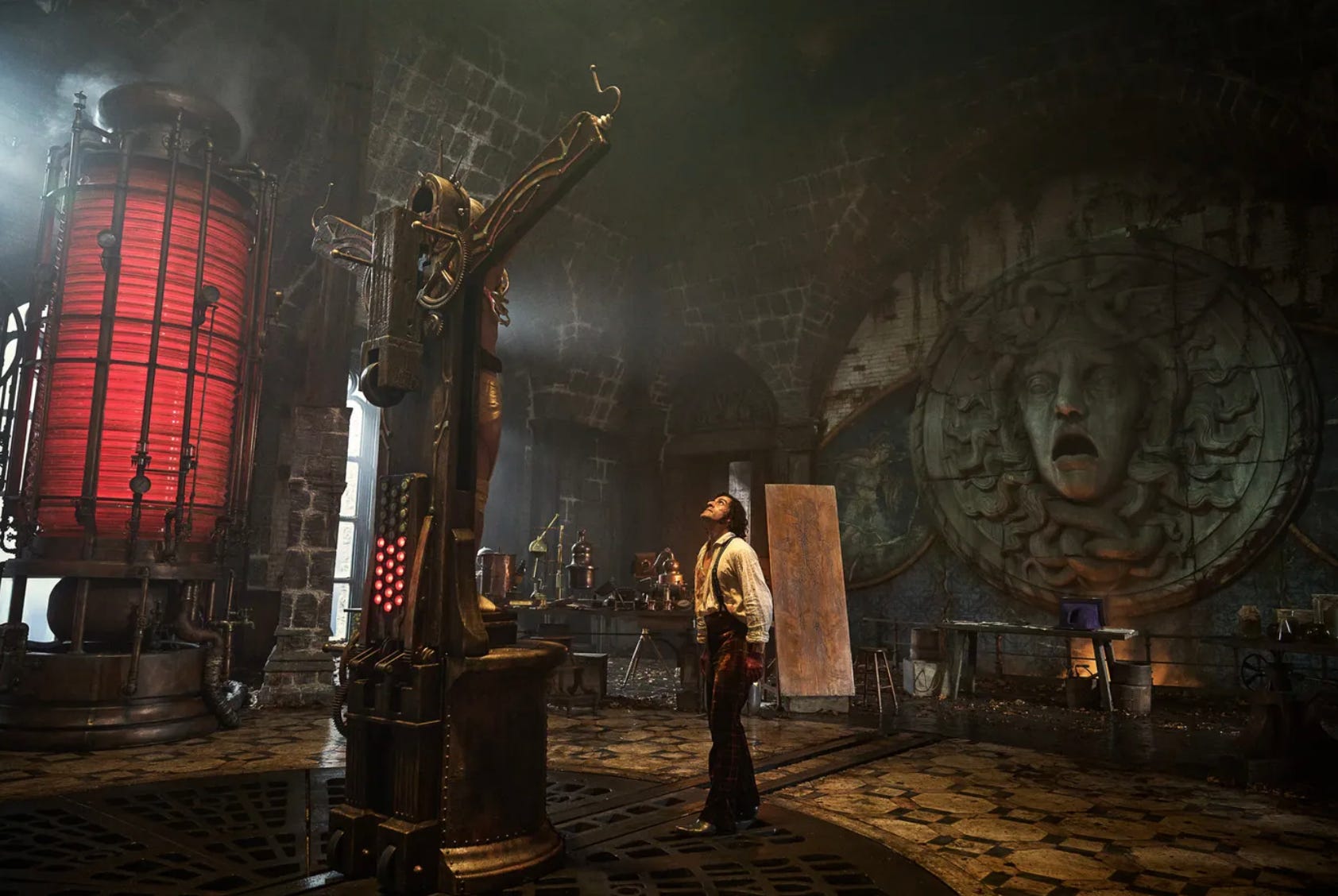
The tycoon’s largesse helps explain the absolutely bughouse castle-laboratory set-piece — a rococo fever dream from the dungeons with marble sluices to the lightning-catching tower with its huge vortical drain and wailing stone face. It’s a triumph, as is the rest of the design work, and justly celebrated, but from the beginning of the film (and before, when I saw stills of it) this and similar touches put me off. The set and costume designs are original and clever, but they reminded me of two decades’ worth of steampunk influences from envelope-pushing fantasy films, from Sleepy Hollow and The League of Extraordinary Gentlemen forward. It’s a style that is by now so familiar that it’s almost like a tic — if it’s the 1800s, everything must be darkly ornate to the point of oppression. (It leaks a bit into Batman movies, too.) In fact, the grimdark style has by now its own aesthetic, and seemed to me to (speaking of vortexes) pull the film into it. I began to wish, despite the pleasure of gigantic photovoltaic batteries and looming vaults, that the thing had been filmed on the old Universal sets so the scenery could do less of the work, or in any case let del Toro’s idea of the drama do more of it.
Anyway the Creature gets created, a large, powerful baby-beast. Though at first delighted, even parental, Victor quickly starts doing the hurt-people-hurt-people thing — especially when he notices his brother’s entomologist bride-to-be, by whom he has been smitten, showing affection for it. The fiancée is shown in Mia Goth’s dainty-but-brainy performance to be his intellectual equal (at the very least), which might be annoyingly expected (preternaturally brilliant 19th Century women are another tic of modern film) but for one of the few really interesting ideas in this version — that Victor’s interest in her is not something that could educate him to tenderness, but rather merely another aspect of his domination drive, which the woman quickly figures out, despite the seeming sincerity of his professions of love. She even throws his apology to her, late in the film, back in his face, which is the opposite of annoyingly expected.
You may have tumbled here to the killed-bride change — sorry for the hidden spoiler! But as long as it’s been revealed, I will also tell you that the instrument of her demise has been changed — while the Creature has for her nothing but tenderness, Victor insists on “saving” her from him, and, well, you can guess.
The Creature would not have done such a thing. His higher instincts are another part of Frankenstein that at first made me leery — shades of Peter Boyle in Young Frankenstein, chasing invisible butterflies! — but over time the logic of it (and Jacob Elordi’s really brilliant performance) got through to me. The Creature’s hurts at the injustice of pain, his joy at finding a friend in the old blind man (and by then Young Frankenstein had fled my thoughts), and his spiteful rage at Victor all moved me. Speaking of that rage, the arctic voyage of the novel is here tampered with in ways that make it more dramatic, including its use as a flashback framing device which shows us the Creature’s rage (and its terrifying strength) well before we learn of its source and everything that came before it. That turns out to be a canny move. By the time del Toro returned to it in the end I was primed for the final scene of forgiveness and redemption — not wholly convinced by it (it does end on an ice floe, after all, and del Toro’s overdetermination is overmatched by the bleakness of Wollstonecraft’s logic and conclusion), but at least rescued me from my premonition, which for me was deliverance enough.
I agree with your take on this version of “Frankenstein,” but feel impelled to point out that preternaturally brilliant 19th century women weren’t invented by movies, “Frankenstein”’s author being a good case in point. Also, in the book Victor is the most insufferable self-pitying ineffective asshole in all of literature, who watches his family and friends be killed by the creature he created but can only relate how miserable he is. I think it says a lot about what the author thought of 19th century preternaturally brilliant men.
That's FRONKENSTEEN 😁