
Oddyheimer
You want Homer, read it
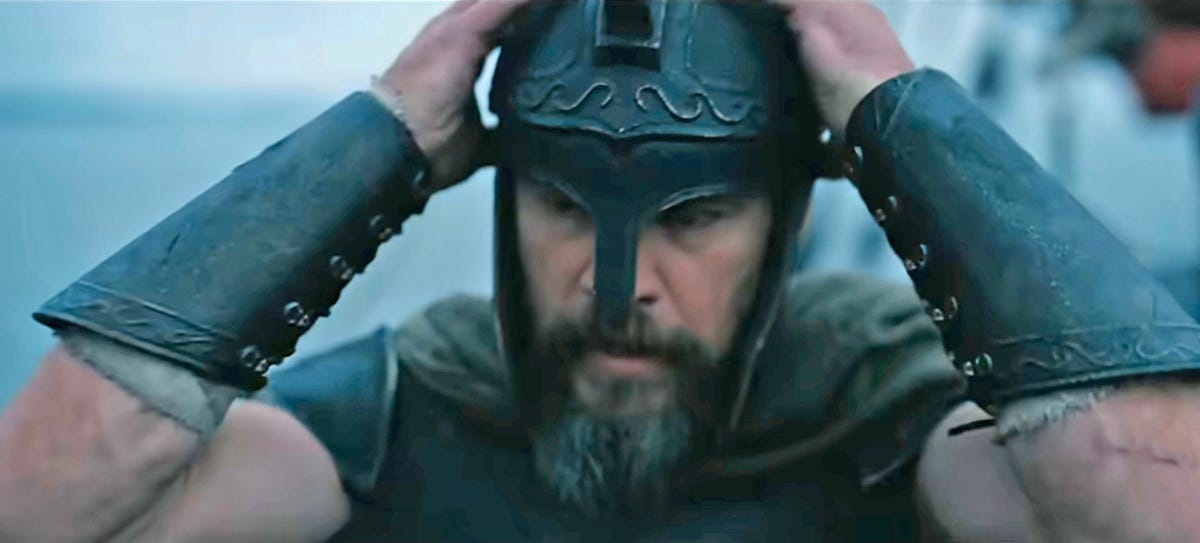
There’s a ton of commentary on Christopher Nolan’s The Odyssey out there and I admit I have sniffed at some of it. But going in I was twice shy; I haven’t read the epic poem since college and what little I got out of it then barely remains, and I was not about to read comparisons of a book I didn’t remember with a movie I hadn’t seen —nor, after I saw it, go back and re-read the great, fat thing for purposes of comparison.
Well, actually, I couldn’t help myself from reading the review by the Homer translator Emily Wilson in LRB, which has raised many hackles. I agreed with a lot of it and applaud most of her observations, withering and astute (like this on Calypso: “never angry, never funny, not skilled in rhetoric, and never consumed by lust for her scraggly mortal victim. She’s an unpaid therapist...”), and what thinking person couldn’t enjoy Wilson’s response to Nolan’s praise of her work based on one tiny snippet of it: very flattering, “but I would be ashamed to have written any part of this script.” I have to agree with her that “every second [of the movie] is jam-packed with incident, lights and noise, and nothing is ever at a human scale.”
But that’s kind of what I liked about it. I mean, I never thought too hard about what Ray Harryhausen was trying to say about the nature of man and society with Jason and the Argonauts, either.
I think Nolan has things to say about the human condition and saw something in Homer to which he felt he could relate. But if every great scholar of ancient literature told us, yes, by George he’s got it (and from what I hear, the trend is running against), it wouldn’t matter at all if what was on the screen didn’t reach us; and I’m still enough of an auteurist to think that, in all but the rarest cases, moviemakers can only reach us with their own stories, whatever other stories they’re supposed to be telling us.
I’m not too versed in Nolan, but it’s not hard to catch thematic connections with Oppenheimer. Like the hero of his prior film, Odysseus is wracked with guilt about his own great achievement — in this case the fall of Troy — and a large part of the film is about his inability to snap back from that. Like I said, it’s been a while, but I don’t think this is what Homer was about.
We don’t know that Odysseus is wracked with guilt at the beginning, because it takes a while for the guilt to sink in; also the narrative is disassembled, so apart from the departure of the victorious Greeks from Troy and the climax with the suitors, we share with Odysseus the confusion he suffers in his years of lotus-eating; the famous events of the story mostly come as recollections.
The siege of Troy is a prominent, repeated flashback, and as we watch Odysseus giving questionable orders that keep getting his men killed (and the looks he gets from Eurylochus when he gives them get funnier all the time), we wonder what it is that’s bugging him. Everything we’ve heard about him, in far-flashbacks and from the bard at Odysseus’ house, suggest he’s a simple hero type; why’s he pulling wacky shit like lashing himself to the mast, ears unprotected, when the ship’s running past the sirens? “This is a bad idea,” Eurylochus says; “No one’s heard the song and lived.” “That’s why it’s a good idea,” says Odysseus, “I’ll be the first.” When he tells Eurylochus about it later, however, he’s not bragging on the pain he endured or the sexy fantasies he carried away — instead he weeps, “It was the song of all the promises I’ve failed to keep...”
There are several other cryptic references to how Odysseus fucked up, and eventually we’re let in on the cause: Thinking up the Trojan Horse routine to breach the city walls, and following that deception with a sack of the city, was a violation of Zeus’ law of hospitality (in the largest sense — think Good Samaritan) and that’s the burr that’s keeping Odysseus bothered and unable to get home. (Every once in a while Zendaya appears to him as Athena to leave little clues.) Odysseus’ sometimes self-defeating (and crew-killing) behavior seems to be a reaction formation to this offense (“To burn the walls of Troy was to burn the world entire”).
Of course, you might ask (as Wilson does) whether Troy was Odysseus’ first massacre; you could also ask whether J. Robert Oppenheimer minded that his invention only ended the world figuratively, and ended World War II literally.
But these are spoilsport questions. The biggest Homeric influence on Nolan’s Odyssey is what makes it the “jam-packed with incident, lights and noise” spectacular that Wilson so disliked: Adventure. Oppenheimer, as befits its self-consciously 20th-Century critique, left its hero dangling in his own suffering, but if the Odyssey is anything it’s an adventure story, just like King Solomon’s Mines, and it even has built-in a (relatively) happy ending, including Odysseus kicking the ass of 108 suitors, like Arnold Schwarzenegger but with gravitas, and collapsing in his wife’s arms. He even gets to expiate some of that guilt!
So Nolan cribbed what thousands before him did from Homer, and if it wasn’t the best part at least we have the satisfaction of knowing that if we could bring forward from the ancient world an early auditor of the poem, they and we could probably agree about the parts that were totally sick.
I didn’t see this in IMAX (nor did I see Oppenheimer in IMAX), but I was content, because Nolan floods the screen with images that are striking not only in execution but also in conception, and anything like that is going to get through no matter what format you see it in. I’m particularly fond of the visit to Hades, a darkling plain on which Odysseus and his men sacrifice a ram and a ewe and drain their blood onto a disk, at which blind Tiresias sprouts from the dirt like a Beckett character to drink the blood and say the sooth.
I also liked Circe’s sculptural method of making the men into pigs, which reminded me of An American Werewolf in London. Polyphemus was always going to be surefire, but the panic and terror of the men as they see their comrades eaten in the darkened cave is genuinely hair-raising — reminiscent in this case of one of Nolan’s own scenes, the child-soldiers trapped in a ship being strafed in Dunkirk.
I really liked Matt Damon in the lead -- not the stereotypical gruff supersoldier, but something more like a man of honor obliged to take up the dishonorable craft of conquest, and suffering quiet PTSD from it. Anne Hathaway is a little actressy as Penelope, though it could be argued that a more becalmed performance would have reduced the apparent tension of waiting on a man she knows must be dead. Tom Holland’s Telemachus and Robert Pattinson’s Antinous are just funny to me — two modern-day pretty boys having a bash at the old sword-and-sandals act, like Tony Curtis. Samantha Morton, on the other hand, gave me strong Lois Smith vibes as Circe, which is to says she chilled my blood.
Yondah lies da castle of my foddah!
Whenever there's a whiff of the literary, GM comes wafting back...
Amazing review as usual, chief. It's always important to remind (as you imply) that every adaptation (or translation) is made for its own time, in its own time. And there's a lot of pressure for a director to stamp an adapted script as their own. (Your comparison to Jason & the Argonauts is apt, though almost no one reads its source, the Argonautika, to check its work.)
I love Wilson's Odyssey & use it to teach from. Her version is very refreshing in that it purges a latent misogyny not present in Homer but accrued across the millenia of translators. Also, she keeps focus on the suspicion that Odysseus is not a reliable narrator of his own story.