
Raging Ball
Not silly sport but survival instinct gives Marty Supreme its spin
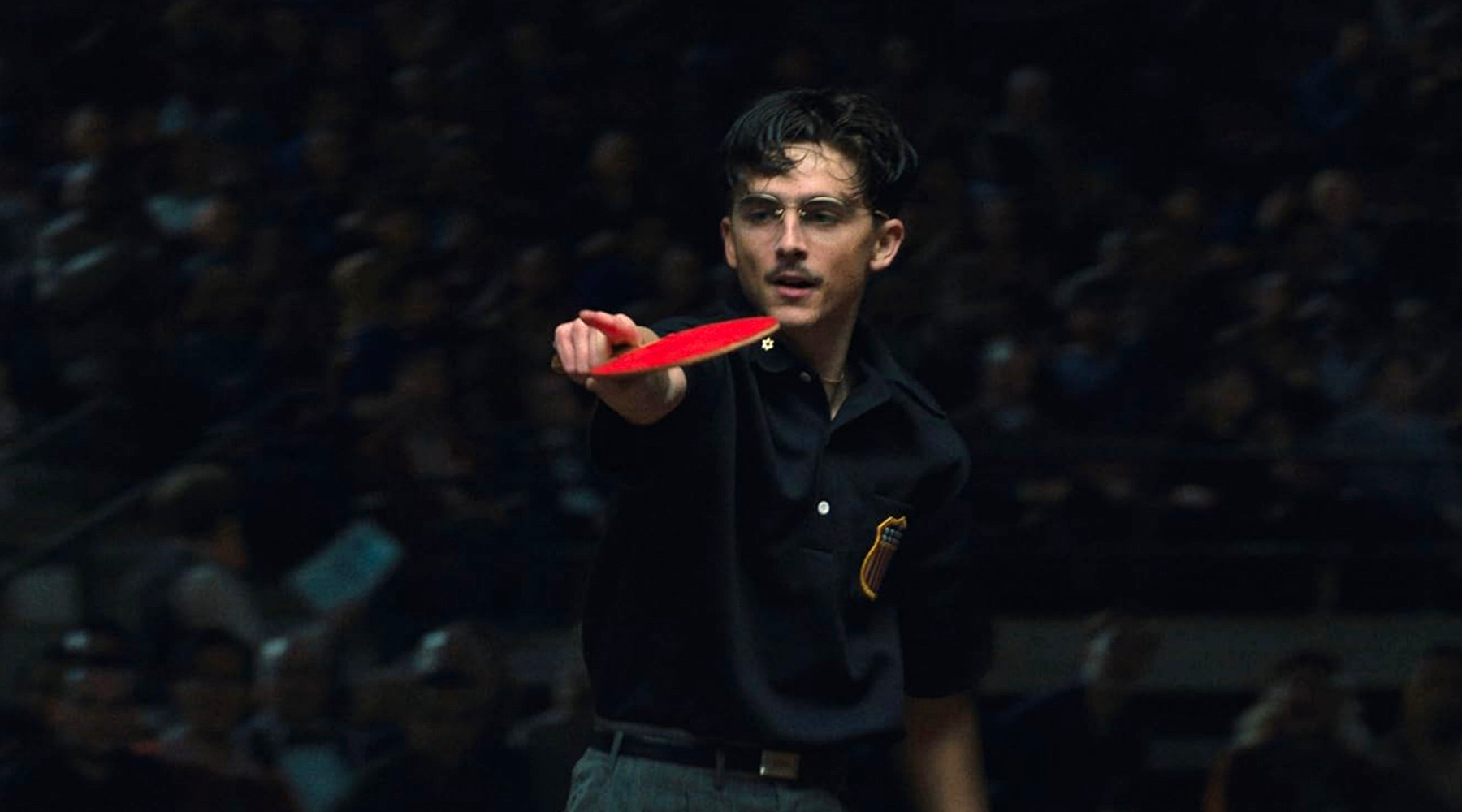
[Oscar nominations are in two weeks and the big show is March 15, so I have to stay on top of the big contenders. Already did Nuremberg and Blue Moon.]
Sports movies are usually heroic. For one thing, they’re usually biopics, and that form (as I’ve argued elsewhere, an intrinsically minor one) indulges the audience’s desire to revel in the hero’s accomplishments and the drive that led to them. Some filmmakers have bigger fish to fry, though, and that’s how you get something like Raging Bull, or for that matter Marty Supreme.
In both these cases, the drive of the athlete in question is shown to be destructive as well as constructive, and the audience is invited to think about what that means. In the former case Scorsese nudges us with a quote from Scripture about taking a gift of vision from a sinner. But Josh Safdie (one of the two brothers who gave us Uncut Gems) is going in another direction altogether.
Marty Mauser is driven for sure: He’s a Lower East Side Jew and world-class table tennis player in the 1950s, when the sport was much bigger in the Anglophone world than in the East, a situation which shifts under Mauser’s feet during the movie.
Marty is charismatic in a way Scorsese’s and Robert DeNiro’s Jake LaMotta is not; where LaMotta is brutish and anti-social, Marty’s a tummler, constantly selling and spieling to make things happen for himself, to get himself over on backers, officials, women, whoever he needs to achieve domination. Both his ambition and his style are nervy, electric, and combative, often even insulting. Timothée Chalamet’s great advantage in the role is his intrinsic charisma; he can motor-mouth and trash-talk and you can at least provisionally buy that people would stick with it long enough to be conned instead of just walking away or punching him in the mouth.
Another difference: LaMotta has a brother who helps channel his self-destructive influences. But no one can tell Marty anything, and his self-destruction runs right in tandem with his ambition — meaning he’s willing to kidnap a dangerous mobster’s beloved dog and steal his money, on the pretense of taking it to the vet, to raise the money to get himself to the championships overseas. (Apparently table tennis in 1952 doesn’t even pay well enough to relieve a top contender’s obligation to make money selling shoes for his uncle.)
The fixes Marty gets himself into are real harum-scarum and anyone who saw Uncut Gems will be familiar with the nerve-stripping Safdie technique for showing this: once Marty talks confederates and victims alike into a dicey situation — like hustling a bunch of small-timers at a Long Island bowling alley with an elaborate con in which his cab-driver buddy (Tyler the Creator! Who’s pretty good!) pretends to need gas money — there ensues a small victory and, inevitably, a spectacular backlash (in this case, spoiler warning, the conned players show up at a most inopportune moment, resulting in the wrecking of the buddy’s cab and a massive gas station fire). Marty cons everyone and, this being a very tough New York environment, the cons always come with consequences.
It’s one damned thing after another like that. Marty has bigger scores, too, including a line on a pen company tycoon (played with gleaming, manicured menace by Shark Tank guy Kevin O’Leary) that he pulls by egregiously insulting him, thereby showing the kind of moxie Marty knows, seemingly by instinct, will get this kind of tough guy to pay attention. Marty also fucks the macher’s wife, an unhappy Hollywood escapee played with appropriate wan bitterness by Gwyneth Paltrow. Marty hangs on tenaciously to get what he can from both of them, ultimately leading to both Marty’s great humiliation and a match that’s both career-ending and a career high.
You might call that a moral victory, if you can accept a morality wholly based on self-assertion. And if the movie is about anything besides dizzying movement and crazy situations, it’s that.
I guess this is a spoiler, albeit well-discussed in reviews: We learn early on that Marty has knocked up his married girlfriend, and at first this seems like one more hurdle to talk his way over (he insists, for one thing, that he’s trained himself to hold his ejaculate by regularly cutting himself off in mid-piss “and counting one-Mississippi, two-Mississippi”). But he also helps her out of her lousy home situation, and she reciprocates by helping out with his cons. Later we realize she’s a bit of a con herself.
In the end it’s as much the birth of Marty’s son as the resolution of his career that breaks his fever; we sense he’ll never be a nice guy but he will be a dad. There are throughout the movie hints of a deeper patrimony behind Marty: an uncle who loves him but is willing to threaten him with prison to keep him in the shoe store; a woman who loves him but is willing to lie to keep him. Tough love, you might say.
And where’s that come from? There are references throughout Marty Supreme to the hard lot of Jews in history: Bigotry, enslavement, Holocaust. The implication is that all the story’s savagery — whether by, for, or against Marty -— is forged in that, and that the struggle to survive persists in his do-anything drive for stardom in his field.
The grand joke of the movie is that Marty’s field is table tennis, literally small ball, a sport Marty proclaims will take over the world but which very few Americans today take seriously. His major quest is, the audience must know, ridiculous. But planting one’s seed is the prime directive. In that sense, self-assertion is the morality of the movie — the existential imperative for a beleaguered people — and Marty’s destiny is to forget all this mishegas and raise his son.
If you don’t buy that, you may wind up feeling as if you were conned. But at least you get something for your money.
All the craft aspects of Marty Supreme are excellent. Darius Khondji’s cinematography is full of scuzzy beauty and Ronald Bronstein’s and Safdie’s editing keeps us jacked up without losing track of what’s happening. All the acting is great, even and maybe especially that of the non-actors: Supermarket tycoon John Catsimatidis, bon vivant Ratso Sloman, writer Pico Iyer, and Abel freaking Ferrara. They keep it real, so to speak, and it’s to the pro thespians’ credit that nobody looks out of place.
As I watched it. I kept thinking how bizarre, that this early chapter of Dylan's life, before he picked up the guitar, has gone untold!
Sorry, but I gotta go (downtown). Enrique Tarrio claims to lead a march today from the Ellipse to the Capitol. No way I'll miss that (if it happens.)
I finally put my recollections in print:
https://thatbern.substack.com/p/cold-grey-day-in-hell