
This gift
Something else pain has brought me
“I just don’t feel good,” my mother said. She’d been getting what she said were steroids from her doctor, a young Indian man in Bridgeport who took Medicare and may have been a geriatric medicine specialist or even a gerontologist; Mom said he knew how to treat old people but maybe she just meant he was polite and helpful. When she was getting the steroids Mom said they made her feel better than she had in years. “I’m gonna be running up the stairs to your apartment,” she said, referring to the fifth floor walkup I lived in, or maybe she we thinking of the other fifth floor walkup I lived in years earlier, the climb to which she laughed about, winded, and never came back to make again.
But then the doctor cut her off. He told her it was no longer safe for her to take them. I said, and looking back I feel bad about this (as I do for so many other things), that there had to be some reason he said it, maybe the way it interacted with some other drug or it was bad for her heart or something. She was not having it. “It was good for me,” she said. “I felt good. Now I don’t feel good, I just don’t feel good!”
When she said it I was sitting with her at her kitchen table, that little table was always covered with a clean plastic cloth with a floral pattern, on one of my infrequent visits in one of those last months before she had to give up the house and go live with my sister and her family. She moved carefully around the kitchen and touched or reached for objects as she went; at the table she was hunched and looked up at me when she talked.
She looked her age but from that angle she also looked like a little kid, a kid who had been through a lot, which she had. She always had this childishness in her, and it rose up from time to time. She even sounded like a little girl now, a bit whiny, as if she were talking about something small that would bother children like getting the wrong flavor of ice cream. This childishness was in her, I saw it, and it froze me, because the thing it called for me to do was gather her up like a child and take care of her. But I couldn’t, because to the day she died, though I was then quite a grown man, she was still the parent and I was the child.
A few years ago I had a big operation on my pancreas. The surgery drugs were very good — Dilaudid, particularly; I kept telling the ICU staff how great I felt despite my big operation and how grateful I was to them all. Back in my room I was weaned from Dilaudid onto less powerful drugs. Slowly I became aware that there was nothing for which to be grateful. I was not in terrible pain, but I was very uncomfortable and I struggled when the nurse asked me to rate my pain (partly because the remaining drugs made this kind of judgment difficult for me). “I don’t know,” I told her, crumpled and baffled. “I just don’t feel good.”
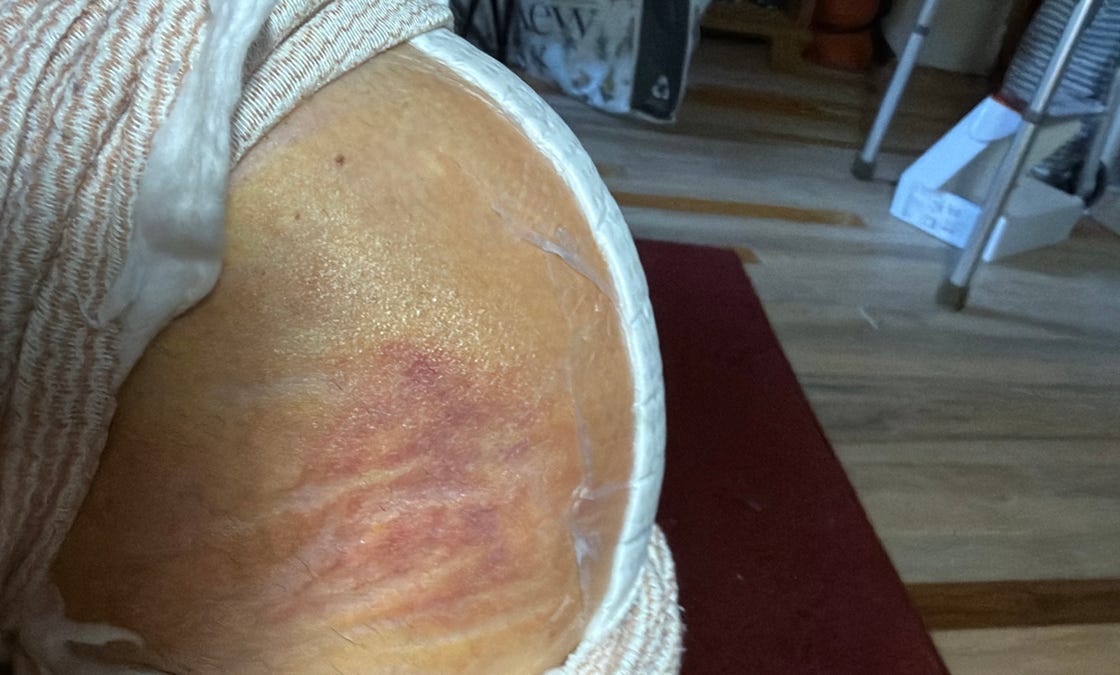
I am currently convalescing at home from major surgery to my knee. It is not so crucial a surgery as that earlier one — in fact it’s performed about fifty times as often, and the success rate is higher. But recovery is much more difficult, a fact I only came to understand after the operation, despite repeated attempts to educate me beforehand. I was careful about avoiding falls but tended to overdo the walking and after a week of what I thought was the start of an unusually rapid return to normal my knee swelled up like a ham and for a few days I was largely confined to bed.
I have gotten more mobile since but I tire easily and even get dizzy, especially as my blood pressure is depressed by the oxycodone, which also constipates me; at the toilet I push down hard on the floor with my good leg and grab the ribs of the radiator in front of me and pull, hoping to shake something loose (and it usually is). Getting the ice packs out of the freezer and taking them to the spare bedroom (where I am sleeping until I can stop waking up every two or three hours) and wrapping my dressing to protect it from condensation before I strap on the ice packs feels like heavy labor, but when I lie down I am restless. The leg gets heavy then tense then hard. At bedtime I strap devices to my shins that squeeze at intervals to discourage blood clots; the little blinking boxes groan like robots trying to get out of bed after a hard night. And in the morning so do I.
Shifting and tangling my covers, I think about my mother. Like her I feel that no one knows how bad I feel — at least in that special way that would get them to do something that really helped, the way kids think pain and suffering can be taken away by magic, or by a kiss where it hurts.
I don’t think my mother ever felt she got that; she certainly didn’t get it from me, at least not while she was alive. I regret not knowing it when it might have helped, but I have the comfort of knowing it now. I don’t have a lot of feeling for the dead. I don’t keep their pictures; I don’t go to their funerals or visit their graves. But I do consider it a blessing and a gift to learn, whenever I learn, what they knew.
Damn, Roy, that was one of the best explanations of what it feels like to be a patient that I’ve ever read. And you say you don’t care about your dead, but you bring your mother to life for us. Thank you for this. For once I have nothing snarky to say. Oh, fuck Ted Cruz!
I appreciate your honesty - truly.
I just celebrated my 69th birthday. It wasn't nearly as fun as it sounded like it might be - To celebrate, I watched The Seventh Seal . I've watched it dozens of times. Anymore, I don't glean any fresh meaning from the serio-comic medieval horror story. The central conceit still makes me smile ( Max Von Sydow spends the film bitching about the God's silence and the lack of any proof in the supernatural. To Death personified.) Mostly, I look at the incredible Black colors in the cinematography. The beautiful faces. The perfect, seemingly casual arrangements of the objects within the frame. ( This time I noticed a black horse in the background of the wild strawberries scene - the one were von Sydow talks about how he would remember the moment for the rest of his life - Spoiler - he's dead by morning)
This time, I think I listened to the words more than I usually do. I took solace in the ending- death is going to happen, but it's OK - You just go dancing, dancing off over the hill with your companions. And I think, once you're over the hill you get to meet up with all your friends and family and dogs and cats ( and horses and mules) that crossed over the hill before.