
Revolutionary Roadtrip
One Battle After Another’s politics are existential, but you can still hiss the villains
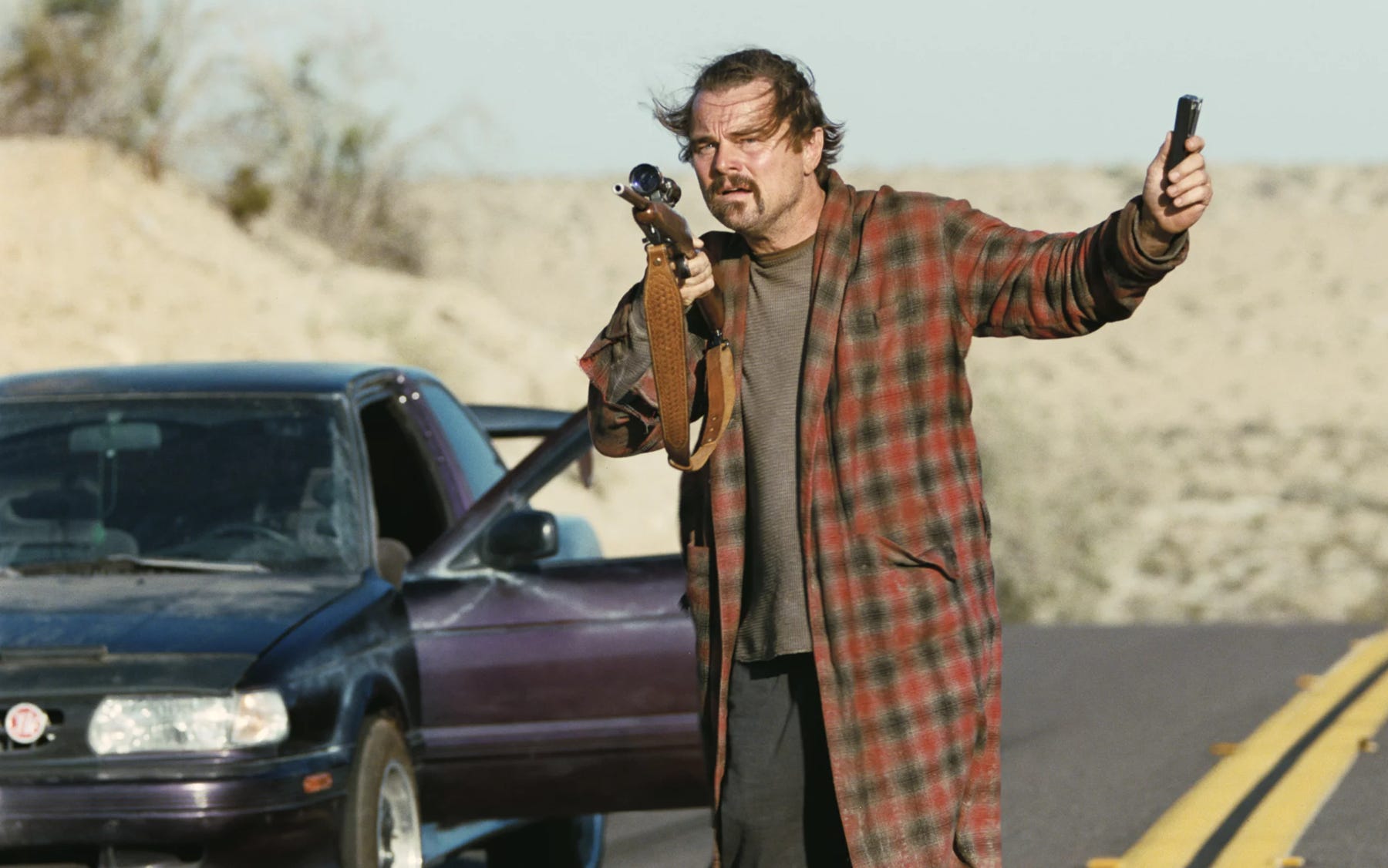
[Like every year, I’m getting some early Oscar favorites reviewed before the nominations come out on the 22nd, and doing fill-ins after. So far I’ve done Marty Supreme, Nuremberg, Frankenstein, Blue Moon, Wake Up Dead Man and Avatar: Fire and Ash. The Great Work Continues!)
Paul Thomas Anderson made One Battle After Another out of Thomas Pynchon’s Vineland, from all accounts a late-80s view of America’s early-80s disintegration, before the current rampages of ICE and the outrage they’ve spawned. PTA could not have missed that nativist trend rising in recent years, but it’s still shocking that its release has not only dovetailed so perfectly with the news, but that it also has the character of a political thriller — especially since his last Pynchon adaptation, Inherent Vice, had a similar freaks-vs.-squares subject but none of the energy and immediacy of the new one.
I say it has the character of a political thriller because, more than any of his other movies (though I haven’t seen Hard Eight), One Battle After Another forces us to worry about the heroes’ crises and dangers in the adrenalized moment-by-moment manner of commercial chase movies. But at its heart OBAA has a lot more in common, I think, with the 2014 film than it seems at first. Though Inherent Vice is murky, reflective, and Altmanesque, OBAA shares its sense of loss for the promise of fading revolutionary dreams — and also its uncertainty that they were really worth having a sense of loss over in the first place.
The plot is much simpler than Inherent Vice’s. In a modern but not too specific era, the revolutionary group French 75 is blowing shit up. Immigration enforcement is one of their causes; abortion is mentioned but not picked up on later. Bob, a hyper white explosives expert, gets with Perfidia, an extremely over-the-top, fuck-all-y’all black powerist, and in addition to making explosions they make a baby. Or seem to — Perfidia has also spent time with Army officer Steven J. Lockjaw, who’s as far out on his strutting, strangled military macho trip as Perfidia is on hers.
But it’s Bob and Perfidia who are parenting Charlene — until one caper goes wrong, Perfidia gets nabbed and (spoilers henceforth) she rats out the crew. Bob hightails it to the sticks with the baby, armed with codes and devices that will keep them untraceably in contact with the remnants of the revolutionaries. Sixteen years later, Bob’s a goofy long-term weed casualty, the daughter (now called Willa) is a brilliant student and martial artist who’s sick of his shit, and all seems stable if sad until Lockjaw, motivated by a need to prove himself to a shadow-government operation called the Christmas Adventurers Club, goes out in search of Bob and Willa.
All these shenanigans are very exciting and beautifully shot and cut. One of my favorite sections has to do with Bob, searching for Willa with the help of the deep undercover Latino subversive Sergio St. Carlos, played with the usual genial sangre fría by Benicio Del Toro, having to keep his middle-aged ass up with St. Carlos’ teen skateboarder operatives, whose silhouettes swiftly flowing along rooftops and against the rising flares of a street riot are as thrilling as the plot. And there is an extraordinary final section on an undulating highway stretch that not only strains nerves in a genre-appropriate manner but also gives a key character a chance to pay off on their promise.
But though I was held, as they say, I was held at a slight remove. For one thing, the French 75 are kind of ridiculous, from their joke name to their Symbionese Liberation Army shenanigans. Teyana Taylor as Perfidia, brash and blustery, and Sean Penn as Lockjaw, stiff and snarling, are two cartoons drawn to one another; as played by Leonardo DiCaprio, Bob seems at first kind of cartoony, too, but as we get more time with him, and he with us, we learn that, while Perfidia and Lockjaw carry the revolution and its reaction with them, for Bob it’s something he’d just as soon forget — apart from some rants about how the Founders kept slaves — and that he lies to his daughter about.
When Bob springs into action, it’s personal and has nothing really to do with the revolution. We may be distracted from this because his opponents and pursuers are so loathsome — not just Lockjaw, but also, and mainly, the much more naturalistically drawn cops and federal agents, who are no-shit frightening in their bland viciousness, just like the ICE creeps and their scumbag bosses we’ve all been seeing on the news. We also see how their brutality slops over, there as in real life, from the Latinos they hunt to the protestors and such revolutionaries that are still around who seek to help their victims.
The revolutionaries may be of some help to the oppressed and harassed immigrants, but in the course of the modern-day narrative we mostly see the Latinos helping the revolutionaries. St. Carlos in particular comes a few times to Bob’s aid, helping him escape the law and feeding him aphorisms and Modelos to calm him down. Is this a debt of mutual aid? Or a joke about the ineffectuality of the would-be white saviors? Whichever it is, like other ironic touches in the movie (e.g. Bob railing at wrong-password treatment from a revolutionary apparatchik), it reduces the political drama of the movie, even as it unpleasantly reminds us of the political drama of our own lives.
Though it has the form of a political thriller, politics is just the MacGuffin. When Bob and Willa get it all sorted out, there’s talk of change and a promise of action, but dramatically it’s about their salvation as characters and human beings — they’re better able to engage with the world because one has shaken off some lies and the other has shaken off some truth. Whatever they do for the cause now is going to be very different from what was done before.
It’s a lot closer to the stoner mysticism of Inherent Vice than to The Battle of Algiers (which at one point Bob is seen watching). But it has similar villains — come to think of it, Inherent Vice has its own commie-hating cartoon character in Doc’s nemesis Lt. Bigfoot Bjornsen. So if ICE makes you see the decisions in this movie in a more inspiring way, that’s not a bad result. If not, you can still enjoy the ride.
Thanks for another review, Roy. I really wanted to enjoy this movie but I couldn't get past the first 10 minutes. The wildly over-sexualized way Teyana Taylor's character is written is a stereotypical throwback to the bad ass bitches of 1970s Blaxploitation movies. It's embarrassing. I imagine many Black women would feel even more uncomfortable about the character than I did. I understand the actor herself has a different take on her role, and that's good, but I was reacting to what I was seeing on screen.
Maybe I'll gird my loins and try again down the road, maybe not.
I wondered when I first heard about this if Thomas was working his way up to Gravity's Rainbow. I didn't like Inherent Vice, book or movie. I think Mason and Dixon could make a fine film. Maybe as a Wes Anderson confection. (This Mark Knophler song is based on Mason and Dixon
https://youtu.be/JMMBZ4W3HUE?si=yegI2PGhk2Z1L4NR
Great album btw!)
They should leave GR alone.
Several reviews of this have mentioned the incredible action sequences which is not a thing that comes to mind when I think of Anderson . Always seemed more Elmore Leonard style, over before you realize what's happening thing.
Good review. Made me think! It is a holiday though. Wasn't planning on thinking today...