
Pandora in the box
Bugonia is shaped like a puzzle but the solution offers sadness instead of satisfaction
[The Academy Award nominations are out, and like every year I’ve been reviewing some of the favorites in the big categories. So far I’ve done Best Picture nominees Marty Supreme, Frankenstein, Sinners, and One Battle After Another, and other-award nominees Blue Moon and Avatar: Fire and Ash. (I also wrote about non-nominees Nuremberg and Wake Up Dead Man if you want to look.) Follow along with me through Oscar night, March 15— movies are magic!)
As I mentioned when I talked about Wake Up Dead Man, I’m not much of a mystery fan, at least so far as the “whodunnit” angle goes. Maybe I mostly mean that I don’t like the aspect of mysteries that involves clues planted for us to discover, or kick ourselves for not discovering, like in a scavenger hunt.
But I’m sympathetic to the argument that many serious works of narrative art are about solving a mystery — sometimes the mystery of the author’s moral preference (as with the plays of George Bernard Shaw), for example, and sometimes the mystery of life itself (which the greatest exemplars do not so much solve as make easier to live with).
Yorgos Lanthimos’ Bugonia has a puzzle for the viewer: Is Michelle, the high-powered pharma company executive kidnapped by Teddy and Don, actually the alien from Alpha Centauri the kidnappers think she is, and thus able to rescue planet Earth from the Centaureans’ killing environmental assaults as ransom? Or is she actually just who she seems to be, and they dangerously deluded eco-freaks?
Bugonia does lean on this is-she-or-isn’t-she plot, but I didn’t mind as much as I might have, partly because it was very cleverly managed (in an script by Will Tracy adapted from a Jang Joon-hwan film called Save The Green Planet! that I have not seen) and partly because I suspected — rightly, as it turned out — that the mystery was not as important as where it was designed to take us. (If it were, they might have explained why a high-powered CEO doesn’t have a bodyguard.)
We learn, bit by bit, that Teddy and Don are the children of Sandy, whose use in a clinical trial of an experimental drug created by Michelle’s company left her comatose. Nightmarish flashbacks suggest the treatment was horrific — tubes everywhere, Sandy blanched and pained. We may presume the disease was worse, but in flashbacks we see (not sure that it happened) Sandy telling Teddy she’s only doing it for the money, for them — which, when she falls into her irreversible coma, the family gets in a settlement.
Sandy also suggests to Teddy a familiar conspiracy theory understanding of modern pharmacology and medicine — they make money by killing you and by curing you. Teddy seems to have taken it to heart (Don, a simple soul, just follows his beloved brother’s lead) and has become a dedicated seeker after environmental truth — and, he tells Michelle when she is captured and locked in their basement, that truth is not the usual Monsanto Roundup shit, at which he scoffs, but that aliens from the Alpha Cenaturi solar system are draining the earth as a food and power source and must be made to stop before humanity winds up like his mother.
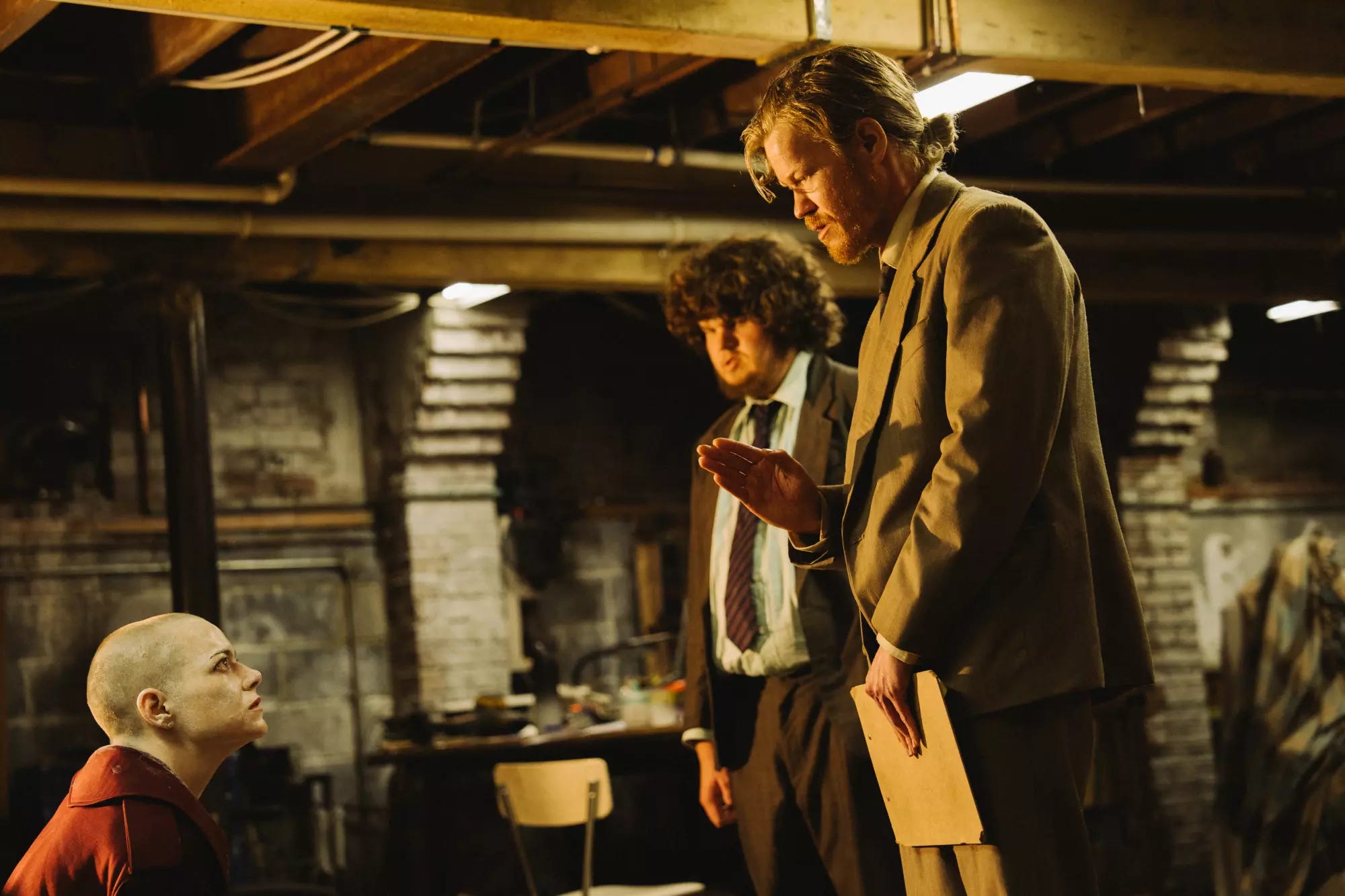
They shave Michelle’s head to keep her from communicating with her home solar system via her hair and coat her body with antihistamine cream for the same reason. The baldness accents Emma Stone’s eyes, which while occasionally fearful are mostly attentive and calculating: She clearly assesses her situation faster than most people would, maybe like a person much smarter than us would, and as Teddy interrogates her — sometimes quite violently — she adjusts in response to his alternating rage, didacticism, and sorrow. She portrays to Teddy her way out as his and Don’s way out — at first, with offers of money and immunity; but when it becomes clear that he can’t be moved from the Alpha Centauri story, she goes along with it and uses that role to offer the earth’s freedom as exchange for hers.
Teddy is a mess, barely held together; Jesse Plemons plays him as someone of considerable intelligence and what we might call vision who has left the duller reasons and rationales of the world behind without regrets but holds onto a great deal of bitterness and rage. His mother’s fate, we assess, is one reason; another is — and here we shade into a mild spoiler — the continued presence in his small-town life of his former babysitter and molester, now a local cop. Stavros Halkias takes a great angle as a dumb guy who’s sincerely apologetic for his monstrous crime but doesn’t seem to realize it was monstrous or even a crime; his subplot serves to remind us that, for Teddy, this is what the world outside his theories feels like (outside Don and Michelle, none of his other human relationships — nor Michelle’s, we may notice — seem nearly as real) and to provide added dramatic tension at intervals.
Eventually the stakes escalate and we find out what’s what. The binary mystery is solved, but there is a lot more to the solution than we may have anticipated — a twist ending, you might call it, that (and I will go no further than this) rather slaps away whatever identification we might have had with either character, though it gives us more and a different kind of understanding and sympathy for each.
And there are still more feelings to be exercised in a long coda built on that revelation. I won’t tell about it, but it describes an event required by the principals’ actions, it makes excellent use of an old novelty version of a sweet little song, and it has lingered in my mind ever since I saw it.
Lanthimos is a tricky moviemaker whose big ideas sometimes get out of control and I found his Poor Things so twee and annoying that I boycotted Kinds of Kindness. But here he is very focused, not in the workmanlike way of a fancy director tethered to a thriller script but like an artist who exercises the balance and delicacy that he knows his story needs. Stone and Plemons are as good as they’ve ever been, and the autistic actor Aidan Delbis matches them as Don, clearly tuned to another wavelength but totally present to every situation. All the craft elements are excellent but special credit to Jerskin Fendrix’s music, which kept me on edge without ever using the propulsive tricks of thriller scores, instead giving us random jolts and thrums that mirror the dangerous uncertainty of the story.
You know, since I lost most of my hair, I'm having real trouble communicating with my home world.
Whoa, whoa – slow down, buddy – I got minutes; your reviews demand hours.