
Baby steps
Sentimental Value isn't my thing, but it's too well done to deny
[Still working on those Academy Award nominated movies. So far I’ve done Best Picture nominees Marty Supreme, Frankenstein, Sinners, One Battle After Another, and Bugonia, and other-award nominees Blue Moon and Avatar: Fire and Ash. Follow along with me through Oscar night, March 15— movies are magic!)
I hadn’t thought about it before now, but just as I have an aversion to vampire movies — an aversion Sinners circumvented — I also don’t really go for family dramas. It’s not that there haven’t been some I liked, even loved. The Best Years of Our Lives is largely a family drama, even with the post-war angle, and so are the films of Sirk, Almodovar, and Ozu.
But you know these are not the kind I mean. When I think about fam-film I think of Father of the Bride — not Vincente Minnelli’s (which I’m not crazy about either) but Steve Martin’s. (Didn’t he, or somebody like him, make like a dozen pictures like that — Parenthood, Grandparenthood, Estranged Sisterhood of the Traveling Pants, et alia?) I think of On Golden Pond, Terms of Endearment, the Disney Channel, Tyler Fucking Perry. Whenever I see a logline involving a wedding, funeral, anniversary, or some other traditional same-surname get-together spot, I get a sinking feeling that I’m about to see old wounds probed, then healed, and big hugs.
I admit this is my own damage. I’m not a family man. Despite my widowed mother’s best efforts, I spent my childhood hungry for escape, and by my extreme alienation made myself outcast. I regret it but there it is, and when I write about works of art that play to feelings which are at best attenuated in myself, I have to make allowances.
Maybe I liked Sentimental Value, which is very much a family drama, as much as I did because it’s classy and foreign — that’s gotten me through some Bergman movies, for sure. Even better, it has a film-and-theater angle. (I bet that helped it with the Academy, too.) And it’s not ostentatious or self-congratulatory about it, which is an achievement in itself. You know how show folk are.
Also it hooked me with the opening voiceover and imagery, which catch us up on some details about the family — father Gustav and mother Sissel, who fight and break up; sisters Agnes and Nora, who live through that together — and about the house in which generations of them have lived. It’s told, and shown, in such elegant literary and cinematic style that I didn’t scoff at the metaphor of the house’s age-old structural flaw.
But mainly I liked it because its feelings are earned. There are some intense scenes, but they never seem engineered to deliver big dramatic effects — like real family quarrels, even when the backstory is dramatically revealed, they seem to come out of nowhere, or from a place only the family knows.
There is a harrowing passage right after the prologue in which Nora, now grown to a star of the Scandinavian stage, freaks out on an opening night and almost bolts the theater. But it’s not a payoff pitch — more like the storm before the calm.
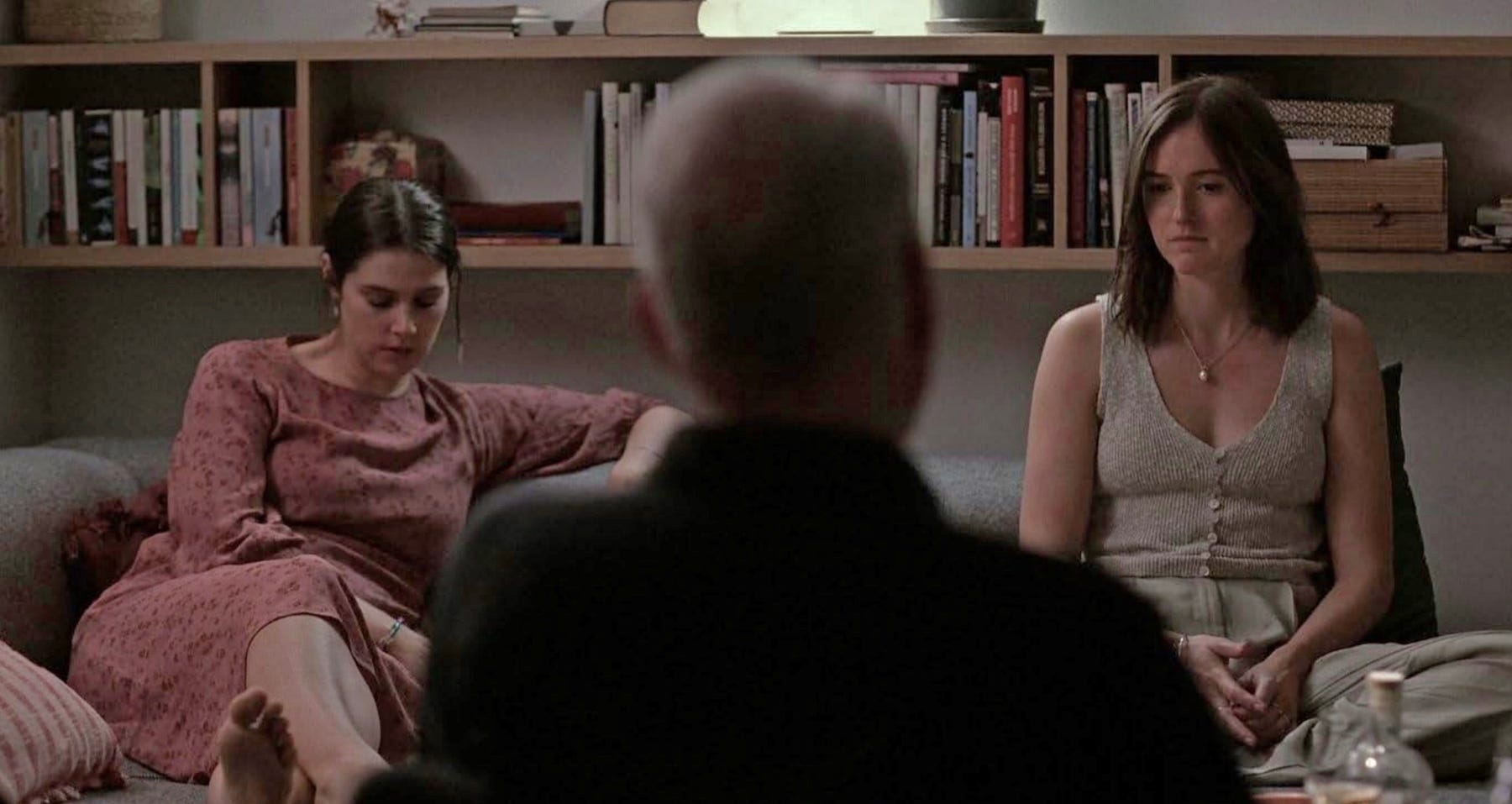
Shortly thereafter we learn her mother Sissel, who we never meet in life, has died. There is a post-memorial gathering in the house, into which Gustav, away for years, quietly slips; seeing Nora, he retreats to a side room. Later she and Agnes overhear him, as they used to overhear him and their mother fighting; Gustav is holding court, affable, unbothered; he’s good with people, authoritative — a film director, we later learn. He meets the girls and they embrace. There’s love in it; also awkwardness.
Over time we get more details. Gustav is indeed a big deal director of art films; he captivates people, including Rachel Kemp, a big deal young American actress who’s at an impasse in her career. He inveigles Rachel to take a lead role in his new script, which has deep autobiographical resonances, though he tactically denies it; her attachment, we understand, will get the thing financed.
But we also know, having seen it earlier, that he first offered the part to Nora, telling her he had written it for her — and she had angrily refused. We also learn that he and Nora at least affect not to follow each other’s careers — Gustav saying he just doesn’t like the theater (or TV, in which she also works), Nora less inclined to dissemble —and that they have things to say about each other’s careers that are unkind. (“I could never marry an actress,” Gustav says; “Oh, but sleeping with them is OK?” says Nora.)
We follow the stories of Gustav’s struggle to get the film made and Nora’s struggle with apparent depression (relationships designed to go nowhere, a tendency to flee and hide). Agnes, married with a child, is for a while seen mostly in the periphery of that, so we may be shocked to learn that the little girl in Gustav’s most famous work, which is at least partly about the little girl’s escape from the Nazis — a story inspired by his own mother’s imprisonment and torture by the Nazis — was played by Agnes, before she abandoned that world to create a family of her own.
Gustav has artistic plans for Agnes, too — or rather for her son, whom he also wants to put in the film — which she rebuffs as angrily as Nora had. It’s not hard to see why. Gustav really is a pill to both of them, mostly to Nora, but Agnes, though conditioned to be a mediating force, gets splashback, too. When Gustav tells Agnes that she could have stuck with acting, you can see the emotional leverage he’s working, and so can she. There’s a key scene in which the old man is pestering Nora to get married: “I’m just saying that children are wonderful. And time flies... You two are the best thing that ever happened to me.” You can imagine how that goes over.
Over time more details emerge, including the suicide of Gustav’s mother (something he’s not above using to draw Rachel into the film). Our impressions of the characters are reaffirmed, but we also get shadings. Gustav, no shock, worries about the reaper, and when he drinks he calls Nora and rambles on her voicemail. Nora tries to get from a theater company what she’s not getting from her family, a classic simulacrum, but finds that its lack of binding ties, which makes it easier, also makes it insufficient.
When Nora, at the end of her tether, finally talks with Agnes about what we take to be a long-undiscussed topic, it’s not confrontational. We do get big hugs, but they’re not cathartic; just a step forward toward a better way.
The acting, in tune with the script, is subtle but hits no less for that. There’s a scene in which Gustav is going to see his longtime cinematographer — the only one who can shoot that new film, he has been insisting — and finds him resting, dozing really, on a chaise lounge. They work up some band-back-together bonhomie, and that calls for a drink. Then Gustav sees him grab a cane to push himself up and fetch the whiskey. “We won’t need hand-held shots,” the cameraman declares as he hobbles along. There are very few words thereafter, on the way to the inevitable, but everything is in their faces.
All the players are great, but I give special credit to Elle Fanning as Rachel. She sticks out among the Scandinavians as a glamorous American, and we may suspect at first that she’s just slumming or misguided, but she shows depth and real artistry and sensitivity, not only to Gustav and his family, but also to whether she’s collaborating or trespassing.
I can watch "Wild Strawberries' repeatedly, for years but 10 minutes of Ordinary People or The Ice Storm makes me want to drink cheap bourbon and play hacky sack in traffic. This sounds interesting though. I find with films like this (modern, foreign usually European) if the plot loses me I can always look at the furniture.
Good review!
Side note, since I hadn’t seen Sinners when REBID covered it: Seeing Buddy Guy in the epilogue made wading through the vampire carnage worth it.