
Tearjerkin
The Shakespeare family drama Hamnet hits harder than it has a right to.
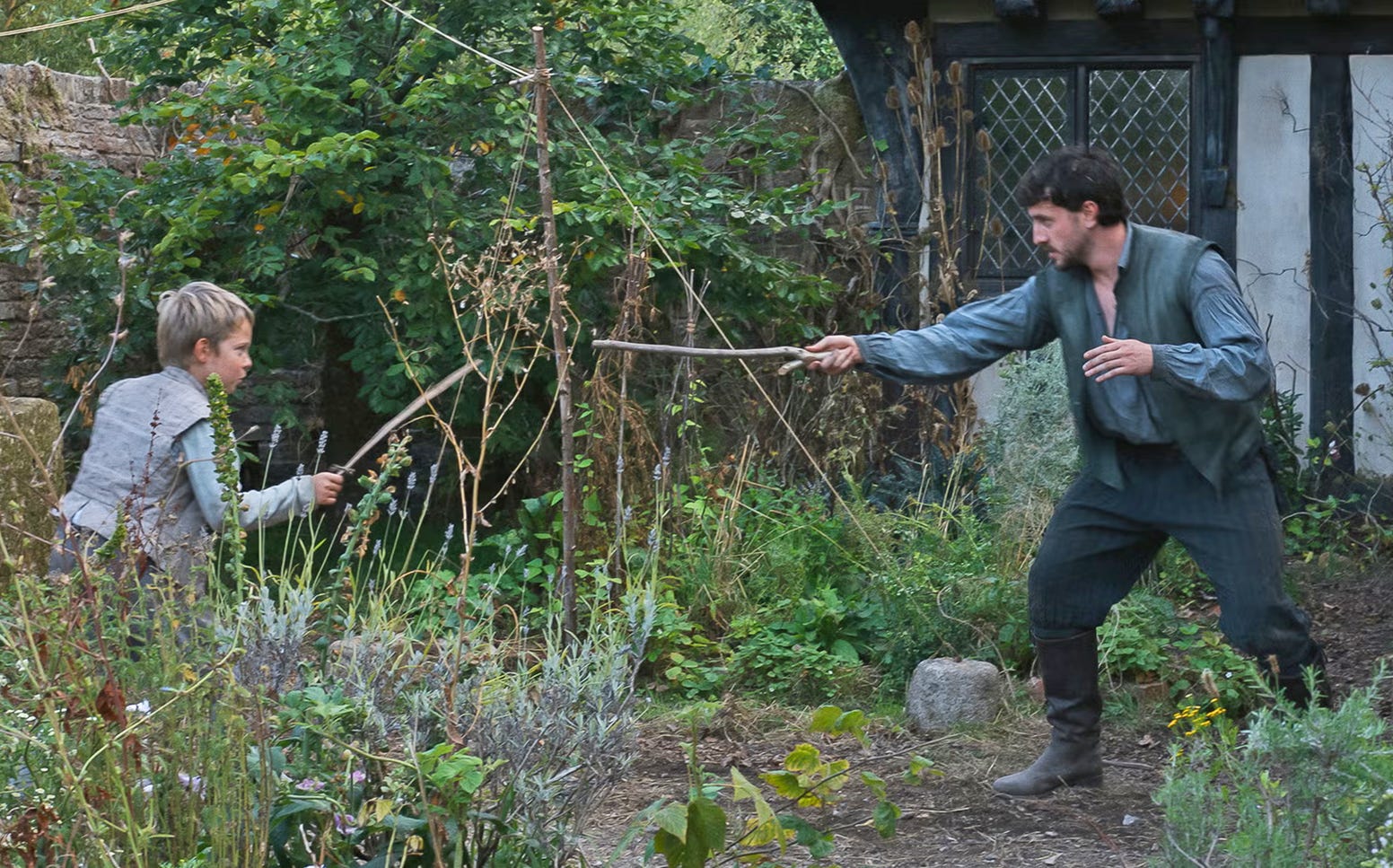
[Still working on those Academy Award nominated movies. So far I’ve done Best Picture nominees Marty Supreme, Frankenstein, Sinners, One Battle After Another, Bugonia, Sentimental Value, and Train Dreams, and other-award nominees Blue Moon and Avatar: Fire and Ash. Follow along with me through Oscar night, March 15— movies are magic!]
I got a kick out of Glenn Kenny’s wonderfully dismissive post on Hamnet (“the ten minutes (or so) showing us every spasm and cough and gob of sputum involved in the passing of the film’s title character was more than manipulative, more than morbid, more than ill-considered. It was thoughtless, and thoughtless as in stupid...”) God knows I relate to Kenny’s aesthetics, and to the implied Manny Farber contempt for the Gimp String. And I see that some other critics are also warning their readers against the film’s imputed manipulations, e.g. Stephanie Zacharek at Time: “‘Hamnet’ Might Make You Cry—But That Doesn’t Make It Great.”
Greatness is for the ages to decide. But I must admit I cried buckets at Hamnet. I also have problems with the thesis; I was aware of these even as I watched the movie, and have some ideas about why these problems didn’t pull me out of the experience.
But, look, my fellow smart alecks, how often do you go to the movies and have the kind of experience that our forebears had at what were then called tearjerkers? It may be that a big part of Hamnet’s appeal, even to those who are baffled by its concept (not “what if Shakespeare but a family drama” — the other one), is the catharsis. I can’t turn my nose up at that, especially since it got me, too.
The story speculates on some of the few facts we have about William Shakespeare’ life: That he had three children with his wife (sometimes called Anne but Agnes in her father’s will, and here); that one child, Hamnet, died while still young; that this name was a variant on the name of the title character of his great tragedy; and that, at the Globe, Shakespeare himself played Hamlet’s murdered father.
Chloé Zhao’s film, based on Maggie O’Farrell’s novel, postulates that Shakespeare wrote the play as a way of reconciling himself and his wife to the death of their child. Now, I haven’t read the novel, but like millions of other people I know Hamlet very well, so this idea was already a heavy lift for me going in. The play certainly obsesses on death differently than most English literature theretofore: Sure, all Christians knew you weren’t supposed to kill yourself, but writers didn’t usually throw that in with a bunch of other pro and cons, as if a man might think his way past religion and custom to a conclusion that very closely resembles suicide. I’ve always taken very seriously the old five-act construction that suggests “How all occasions do inform against me” is the turning point — Hamlet volunteering, so to speak, to join the march of death. It’s hard to see a lament over the death of a child in there.
Zhao and co-screenwriter O’Farrell lead with the story of Agnes’ and William’s courtship and marriage. Apart from the children, other characters are kept at a distance; for most of the film, especially once the leads detach from their birth families, we focus so much on the couple and the kids that, except for the last scenes, all society seems very remote.
At rise we find that Agnes likes to hang out in the deep woods around a cave opening, falconing her hawk (fnar fnar). That opening screams Female Principle; we learn Agnes’ dead mother, imputed to be a “forest witch,” spent a lot of time there, and Agnes revisits it to give birth to her first child. (In the aftermath of that, Shakespeare gazes into that void and fear crosses his face. Men!)
Portals get centered throughout the movie (doors and windows, dream thresholds, a stage drop for Hamlet), and as they do their symbolism moves back and forth between birth and death, and then to what may come after that puzzles the Will.
When he’s not writing, Shakespeare, battered son of a douchebag glover, is amusingly less eloquent than Agnes. (OK I mean who knows, but it’s not like he’s Neil Simon.) He’s not intimidated by her, though, and she’s drawn to him; she tells Shakespeare she sees “landscapes” in him, and her brother that she sees “more hidden away inside [Shakespeare] that anyone I’ve ever met.”
The daughter of the forest witch is much given to such insights, but we come to learn (and, to be honest, literary history is kind of a tip-off) that Shakespeare is intuitive in his own way. Where Agnes’s intuition expresses itself in the demi-magic of home remedies and premonitory visions, Shakespeare’s comes in clots of speech that sometimes distill into poetry — at one point, he gets drunk at his desk and seethes, and when Agnes tells him he’s a good man he responds that, to the contrary, he’s a “violent, dangerous man.” It’s not too hard to get from there to “I am myself indifferent honest,” etc., and later we see those lines going into Hamlet, along with a few others.
They have their kids and their home is a glowing island of love in a primordial forest, which Shakespeare sometimes abandons to make money in the big city, first with gloves, then with plays. Sometimes, as with many another commuting parent, this means he misses big family events — like the birth of two children (the twins Hamnet and Judith) and, later, the death of Hamnet. Agnes never likes his absences but after that last one grows cold to Shakespeare; he can go to London and stay in London, she says; she and the surviving children will be fine.
The trauma is made vivid. When she gives birth to the twins we are shown her agonies, and her terror that the omens are bad. But the horrors of the plague are worse; Judith gets it first, and her twin secretly prays to cheat Death of her company with their old trick of each pretending to be the other. He goes, and not easily, almost as if Death has detected and resents the cheat. You can imagine what this bubonic roulette does to their empathic mother, and if you can’t, Zhao, and Jessie Buckley as Agnes, make sure you find out in detail.
Why did I not resent this? Partly it’s Buckley; this is a you-better-believe-it acting situation and she completely succeeds. More than that, it’s because I had been pulled in by the family drama, which as I mentioned is insular and discourages even normal social context for its events; otherwise, the high rate of childhood death at the time might have softened the impact. (We also have Emily Watson as Shakespeare’s mother giving a little speech that — in her playing, not so much the words — suggests how deeply buried the sorrow of expecting one’s children to die must have been.) Besides that? I guess it just touched me. I’m allowed.
Here’s where making Shakespeare a man of few words turns out to be a canny choice; in addition to keeping wisecracks out of the picture, seeing him stalk shadowy London, and speak “to be or not to be” while staring into the inky Thames, makes his otherwise inchoate agony at least a reasonable breeding ground for the poetry of Hamlet. (Also this suits Paul Mescal’s quiet acting style much better than a chatterbox Shakespeare would have.)
The stickier point is the finale, centered on a performance (maybe the debut) of Hamlet at the Globe. It’s a grand conceit that makes emotional sense for sure — how can one not react to Shakespeare as Old Hamlet saying “Adieu, adieu, remember me” to a young actor closely resembling his lost, fair-haired boy — in fact, played in the film by the older brother of the actor who plays Hamnet? I’m all for such logical overrides of movie magic. (I’m a big fan, for instance, of Robert Aldrich’s ...All The Marbles, in which we are expected to believe the California Dolls legitimately win a foxy tag-team “wrestling” match as if it were college Greco-Roman. That’s about as willing-suspension-of-disbelief as it gets.)
But even while I was feeling the feels, I was also smelling a rat: Obviously it’s not the dead boy who will do the remembering, but the parents; probably Richard Burbage didn’t look like that; does Agnes really not know she’s not supposed to talk during the performance, etc. But this is not the Hamlet we all know: This is the play as Hamnet’s parents see it. Zhao and O’Farrell are making a private epiphany out of this public event. Well and good, but then, with a gesture, they seem to draw the world (the Globe!) into Agnes’ mourning, as the play presumably will do down the centuries. This is a higher order of magic and I can’t say as I quite get there with her. But still the tears came.
The vision is uplifted at every level of craft; I’m especially fond of Max Richter’s music, simultaneously ethereal and earthy, and the cinematography of Łukasz Żal’s, who isn’t afraid to darken and flatten a scene to achieve his effects. But I have to give it to Zhao. I couldn’t quite find my way to Nomadland, either, but that journey didn’t do anything near as much to me.
Thanks Roy. I feel a push-pull with this film -- I've bought the movie and intend to watch it, largely because I'm a huge Jessie Buckley fan. I put her in the same category as Stanley Tucci and Delroy Lindo: you know every movie is instantly going to be made better by their presence. But I'm an even bigger Shakespeare fan, and I'm very ambivalent about a movie that strikes me as Shakespearean fan-fic. I had the same problem with Shakespeare In Love, which everyone raved about. So I'll get to watching it eventually, but with some trepidation.
I wondered what this movie was about, watching the trailers foisted on me on YouTube. Now I know and don't have to subject myself to the tearjerk. Babe is good enough for me. That'll do Pig.