
Past the Mischief
The Secret Agent is a thriller, but it’s the discursions that make it
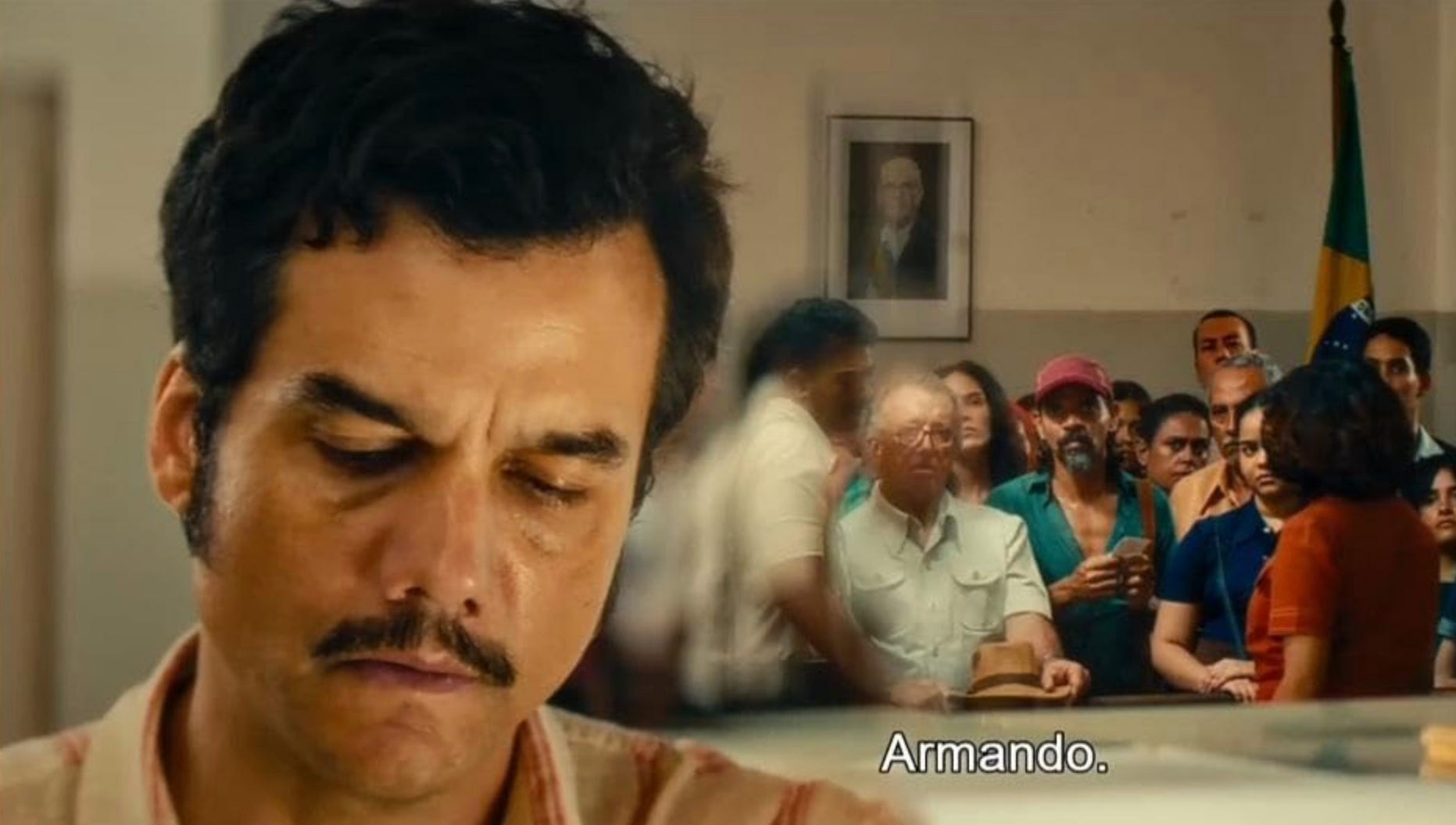
[Still working on those Academy Award nominated movies. So far I’ve done Best Picture nominees Marty Supreme, Frankenstein, Sinners, One Battle After Another, Bugonia, Sentimental Value, Train Dreams, and Hamnet, and other-award nominees Blue Moon and Avatar: Fire and Ash. Just a few more and I’ll be ready for Oscar night, March 15— follow with me, movies are magic!]
I think everyone has limits on how much caprice they can stand to have in their film experiences. By caprice I mean shifts — sometimes in narrative, but often tonal — that strike the viewer as willfully out of sync with what they’ve been watching, or with what they’ve been led to expect they’re watching. I’m thinking, for example, about the scene in Lindsay Anderson‘s If.... after we see (or seem to see) the Chaplain assaulted and possibly killed by the students; they are being admonished by the Headmaster in his office as if they’d been caught carving their names in a desk (“I take this very seriously”). He then tells them they must apologize to the Chaplain, and retrieves him living from a large cupboard drawer, from which the Chaplain sits up to shake their hands. A lot of trippy shit happens before that, but until that point the reality-vs.-fantasy boundaries seemed clear and I recall experiencing the scene as a break in my faith with the film.
That was years ago, and I have since gotten a little more tolerant about shifts like that. Still when I see movies that veer off in curious directions and I don’t feel absolute trust in the filmmaker — as with Emilia Pérez a few years back — I get itchy.
It took me a little while to settle in with The Secret Agent, Kleber Mendonça Filho’s expansive story of a man who runs afoul of the authorities under the Brazilian dictatorship of the 1970s, because I felt at first misled like that. But I came to think the movie was about more than I had thought, and the better for it.
The story comes at us aslant; we quickly get that Armando, who we first see gassing up his car at a remote service station within sight of a corpse covered in cardboard, is nervous about the police; when he gets to town he hooks up with other people who feel similarly, none of whom seem to be criminals. They are all under the care of Dona Sebastiana, a sort of dissident den mother and one of those old ladies who know everything and everyone, have severe osteoporosis but seem indestructible, and dispense love and wisdom as if placing a shopping order. Along with the refugees and political outlaws, Dona Sebastiana is keeping a cat, whose provenance is explained in one of the story’s many stray details, and who has two faces.
Armando, we learn eventually, is back in his hometown of Recife to get his young son and himself out of Brazil. As we learn even more eventually, he is the former head of a university engineering department who had a bad run-in with a corrupt official mobbed up with the regime — racist, sexist, fascist, whole nine yards — who dismantled Armando’s department to enrich himself and whose adult son was sufficiently disrespectful toward Armando’s wife to get punched.
Armando — known alternately now as Marcelo — been moving around since; his own son is living with his wife’s parents and his wife is dead. When he comes back, despite the best efforts of Don Sebastiana and others, the corrupt official, whose private business is now thriving on (we assume) such looting as he pulled with Armando and his colleagues, gets wind and hires hitmen.
This is the hard thriller at the center, but plenty of chewy details surround. For example, much later than convention might suggest, we learn that a young 21st-century archivist is going through tapes made by these dissidents; her empathy and impatience with the ellipses in the evidence mirror our own.
I guess those tapes were made in anticipation of some future national reckoning. There are a few references in the film to the “mischief” from which Brazil suffers, and to the characters’ hope for an end to that, as if they can imagine and look forward to it — which under our current circumstances is encouraging.
That attitude toward mischief became for me a key to the film’s discursive approach. Mendonça has talked about his own youth in Recife and how much he loved its clatter and roar when growing up; also, much of the film takes place during Carnaval, which intensifies every intensity. And throughout there’s that elegiac feeling often found in films made after a nation’s days of democratic collapse, like I’m Still Here, Pan’s Labyrinth, Parallel Mothers et alia. (Hispanophone artists seem to have a special feel for it; odd, as their master Buñuel seemed almost to take it in stride.)
After a while I got the idea that it was important for Mendonça to show me Armando’s world, and his own, with all its mess — not just the dissidents and their earnest advocates, with their harried heroism, but also the lives around them, including the hitmen (drunken cashiered Army officer, grim knife-faced young no-chancer, and the wild-eyed miserável Vilmar who they think they can use because he’s poor but who shows them something), and the barely-story-related guys like the greasy police chief and his swaggering lieutenants, the haranguing street poet, the old German officer turned tailor, revelers fucking in the park, etc. Not to mention the surreal subplot of The Hairy Leg.
The method is not that different, I think, from Sam Fuller’s in Pickup on South Street and Jules Dassin’s in The Naked City; just a little woolier. This is a thriller but at least as much a dream film of the artist’s youth, weathered with memory and stained with the blood of his heroes.
Don’t get me wrong; there’s enough tension built in to pull you through the whole 160-minute runtime anyway. And some of the shadings give also a good sense of the strained and sorrowful condition of the dissidents, and how it tears them up to maintain their double identities (and here the two-faced cat makes her callback). There’s no forgetting the stakes.
But around that there is also abundant life. I especially loved the youngish woman who works in the fake police station (long story) where Armando is set to pass time while waiting for his fake passport. Full of face and pockmarked, modishly but not provocatively dressed, hair swept back in a mane, she bangs slowly at her big manual typewriter but with no paper in it. Armando notices; “I’m a commissioned position,” she explains. Eventually she gets paper, types on it, regally marches over to Armando, hands the paper to him, and goes back. “Dear newbie,” the red typing reads, “Are you married? And/or do you enjoy the company of women?” Armando chuckles, embarrassed; at her desk she coolly awaits his answer.
It’s no shock the lady would thus confront Armando; Wagner Moura is very handsome and charismatic, and has in the role not only understandable sadness and suspicion but also a sweetness that, one senses, he has carried with him all through the drama and pain. I will add — and this is certainly a spoiler, so maybe skip the rest of this paragraph if you plan to see it — that the praise for his performance gains from his second role, late in the film, as Armando’s son, now a doctor, visited by that troubled archivist in search of story details. Moura clearly absorbed characteristics for this part from the young actor who played the son, and his portrayal is distinct and individual; but at the very end, after he has told the young woman he doesn’t really remember his father, and that there are parts of the story that he doesn’t feel like talking about, as he stands alone in the evening glow I swear to you that the face of the father flickers on and off in the son’s. I am happy to sacrifice some clarity, and accept some caprice, for moments like this.
Caprice... say, wasn't that a Doris Day comedy/thriller where she's a spy stealing secrets from a cosmetics company?
Moments of clarity? I long for the lost gardens of Cordoba. I think all of this is very far from Damascus and none of it seems Kismet, let alone cricket, what?
The archivist of our own future may very rightly ask us if we still have the fiddle we played while the town burned down. "I was trying to keep the spirits of the others up, including the firefighters!"
And yet I am grateful for this music and descriptions of bits of movies I have seen and out of the focus of the piece, a film I am unlikely to watch at such a length, unless I end up in a prison hospital where the warden's idea of torture is to show subtitled films continuously, interspersed with classic surfing clips. "Wipe out!"
And I still live for these flashes, the flickering faces on film. THANKS!